

Arizona Legislation Proposes Elimination of Speed Limits on Rural Interstates
Wild Horizon/Universal Images Group via Getty Images
The most significant car news and reviews, no nonsense
Our free daily newsletter delivers the essential stories straight to you every weekday.
The American West is known for its vast landscapes, but it can also be less exciting due to its monotonous interstates with little more than sparse vegetation for miles. Arizona Representative Nick Kupper has proposed an idea to make the state's highways a bit more interesting by eliminating speed limits on certain rural roads during the daytime. He also suggests that 80 miles per hour would be safe even at night on stretches like Interstate 8 south of Casa Grande.
These proposals are included in the Reasonable and Prudent Interstate Driving (RAPID) Act. If approved, a pilot program would be conducted on the previously mentioned section of I-8. This legislation was introduced earlier this week, on December 15, and residents are already expressing their concerns regarding Kupper's proposal:
“I think that’s insane,” one driver told Phoenix news outlet Fox 10. “I have no idea what he’s thinking!”
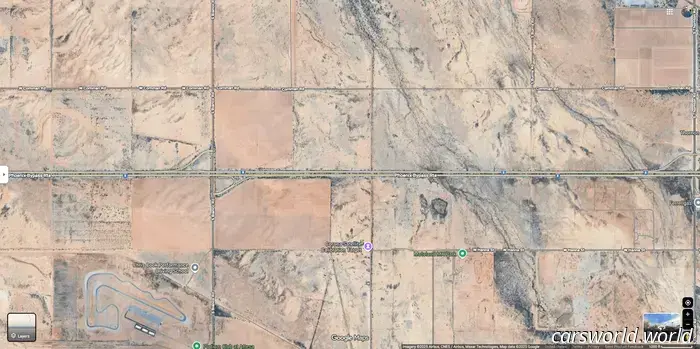
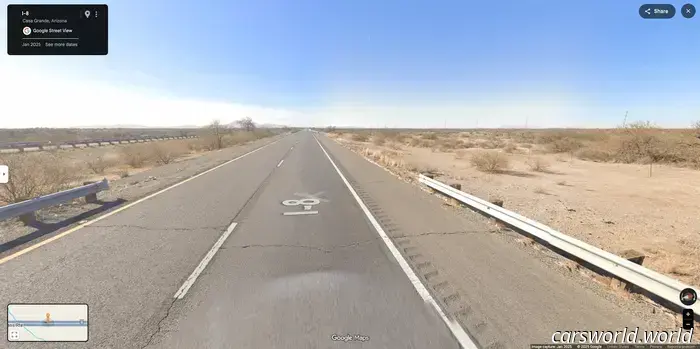
Yes, not much out there. Google Maps
Kupper informed Fox 10 that he designed House Bill 2059 based on practices in Montana and Germany, the latter being well-known among car enthusiasts for its autobahns. While some German autobahns have posted speed limits, others do not, allowing drivers in V12 supercars to speed past VW Golf hatchbacks without fear of being stopped.
“Both found that about 83% of drivers remained around 77 mph because that’s where they feel at ease,” Kupper explained. “Drivers in these areas tend to maintain a more similar speed relative to each other compared to speed limit zones, which is a crucial reason why these zones are actually safer.”
The RAPID Act specifies that unrestricted speed zones can only be established “outside an urbanized area with a population of 50,000 or more.” Additionally, the highway segment must have a crash rate lower than the statewide average based on data from the past five years. Adequate infrastructure is the final requirement for a road section to have its speed limits lifted, as HB2059 mandates that state highway and transportation officials establish standards for what is deemed acceptable.
As I interpret it, the RAPID Act offers drivers greater autonomy in determining safe speeds in unrestricted zones.
“A person shall not drive a vehicle on a highway at a speed greater than what is reasonable and prudent according to the existing circumstances, conditions, and the actual and potential hazards,” it states. “A person shall manage the speed of a vehicle as needed to avoid colliding with any object, person, vehicle, or other conveyance on or adjacent to the highway while adhering to legal requirements and the general duty to exercise reasonable care for the safety of others.”
Similar systems can be effective, but whether such success can be replicated on Arizona roads is uncertain. Is Kupper’s idea misguided, or could it be valid? I think it’s too early to judge, but I find it hard to trust my fellow Americans in this matter.
Have a tip or question for the author? Reach out directly: [email protected]


Other articles
 Why Do Artificial Gear Shifts in Electric Vehicles Frustrate People So Much?
Our report about Porsche introducing artificial gear shifts in its electric vehicles sparked strong reactions from both electric vehicle enthusiasts and traditional car lovers.
Why Do Artificial Gear Shifts in Electric Vehicles Frustrate People So Much?
Our report about Porsche introducing artificial gear shifts in its electric vehicles sparked strong reactions from both electric vehicle enthusiasts and traditional car lovers.
 EU Withdraws Ban on Sales of Gas-Powered New Cars by 2035: TDS
The new goal is to achieve a 90% reduction in car CO2 emissions by 2035.
EU Withdraws Ban on Sales of Gas-Powered New Cars by 2035: TDS
The new goal is to achieve a 90% reduction in car CO2 emissions by 2035.
 Mercedes-Benz is on the brink of launching a new design era: TDS.
After 18 years, Mercedes-Benz will appoint a new individual to lead its design department.
Mercedes-Benz is on the brink of launching a new design era: TDS.
After 18 years, Mercedes-Benz will appoint a new individual to lead its design department.
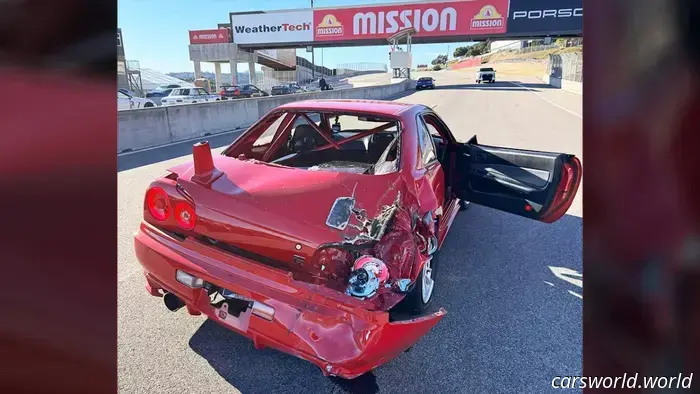 Skyline GT-R Owners File Lawsuit Against Laguna Seca After Tractor Collided with Stationary Vehicles During Red Flag Situation
A track day took a disastrous turn when a worker crashed into a stationary R32 and R34 Nissan Skyline, with the drivers still inside the vehicles.
Skyline GT-R Owners File Lawsuit Against Laguna Seca After Tractor Collided with Stationary Vehicles During Red Flag Situation
A track day took a disastrous turn when a worker crashed into a stationary R32 and R34 Nissan Skyline, with the drivers still inside the vehicles.
 Lexus aims for the new LFA to "redefine the audio experience of an electric sports car."
The order was issued directly by chairman Akio Toyoda.
Lexus aims for the new LFA to "redefine the audio experience of an electric sports car."
The order was issued directly by chairman Akio Toyoda.
 Ram Has Just Teased a High-Performance Off-Road Truck That Appears to Have a Turbocharged Engine.
Is it possible for the TRX to come back with a turbocharger instead of a supercharger, or is it something different?
Ram Has Just Teased a High-Performance Off-Road Truck That Appears to Have a Turbocharged Engine.
Is it possible for the TRX to come back with a turbocharger instead of a supercharger, or is it something different?
Arizona Legislation Proposes Elimination of Speed Limits on Rural Interstates
The RAPID Act has the potential to transform isolated segments of roadway into American autobahns.