
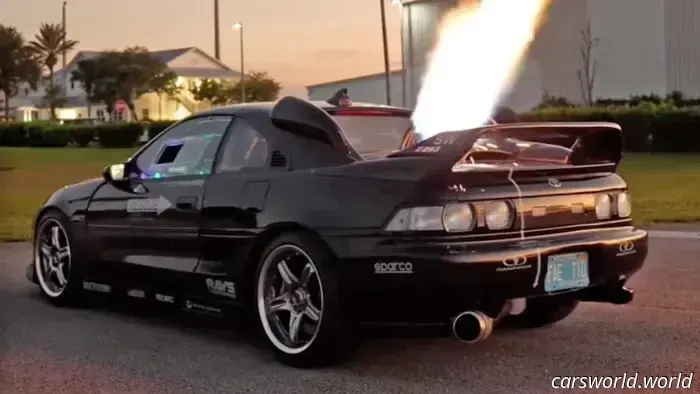
This Toyota MR2, equipped with a supercharger from a Chinook helicopter turbine, can shoot flames.
@asher_hedegard / @pzmlab via Instagram
The most significant automotive news and reviews, no nonsense.
Subscribe to our free daily newsletter to receive the stories that truly matter straight to your inbox every weekday.
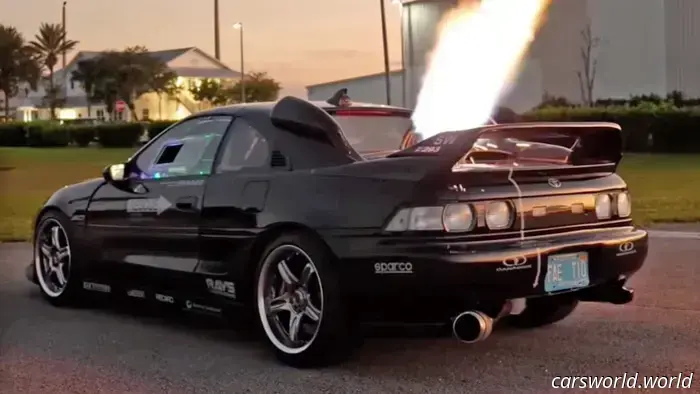
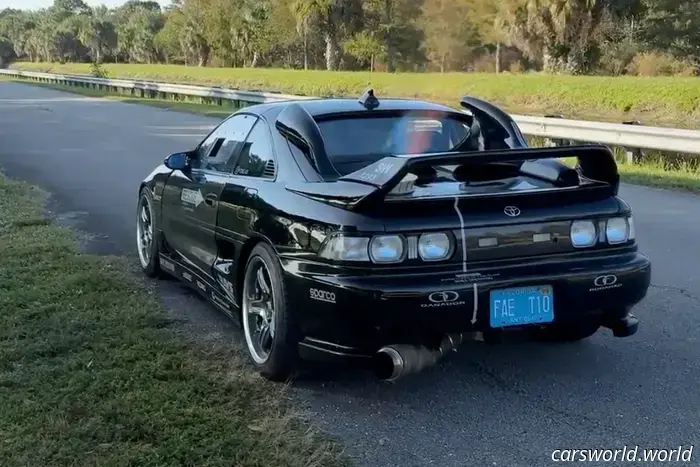
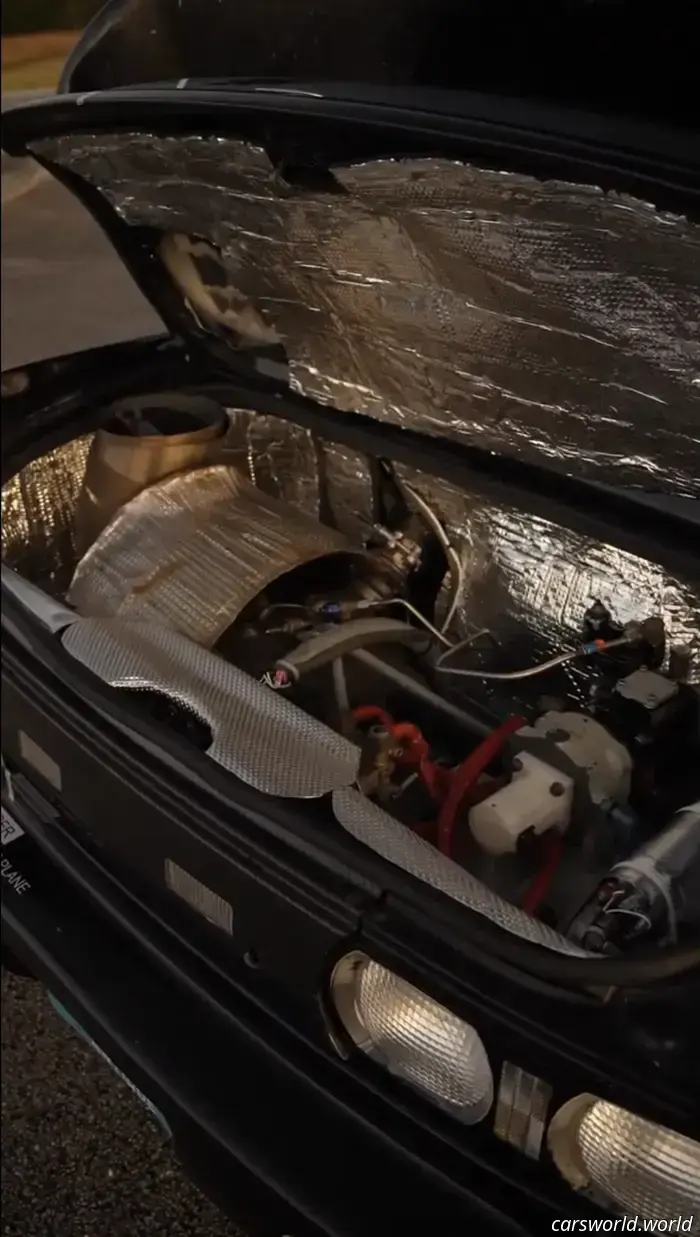
You could be forgiven for assuming that the SW20 Toyota MR2 has already undergone every possible modification. That’s what I thought until I came across this one featuring a turbine in the engine bay. Unlike your neighbor’s K-swap, this is why I wanted to interview the owner: to find out more about this aviation-inspired sports car that opts for something beyond traditional turbos.
“My hobby revolves around jet engines,” Dustin Brice shared with me over the phone. “One day while I was in the garage, I watched a Fast and Furious movie featuring a car with a jet engine in the back providing electrical power for a device on the vehicle. I thought, ‘That’s really cool.’
“That got me thinking, and I realized that I’ve always wanted to install a turbine in a car. So I decided to harness air power from the turbine to supercharge a piston engine. That’s how the concept was born.”
Fortunately, Brice works as a machinist at a research company specializing in jet engines. This partly explains how he came to acquire an auxiliary power unit from a Chinook helicopter. Instead of replacing the 2GR-FE V6 from a 2008 Sienna minivan in his MR2, he chose to integrate both. The aircraft APU now serves as an extreme blower, generating between 6-8 psi of boost.
The challenge was to configure the turbine to produce air instead of electrical or hydraulic power, as is the case in helicopters. Luckily, Brice found another version of the turbine that does provide air, allowing him to simply swap out some components. Although I’m not familiar with such hardware, he explained, “There are many different types of turbine engines that generate air. They all function similarly—varying designs of how the compressor and power sections operate, but it’s a common engine type.”
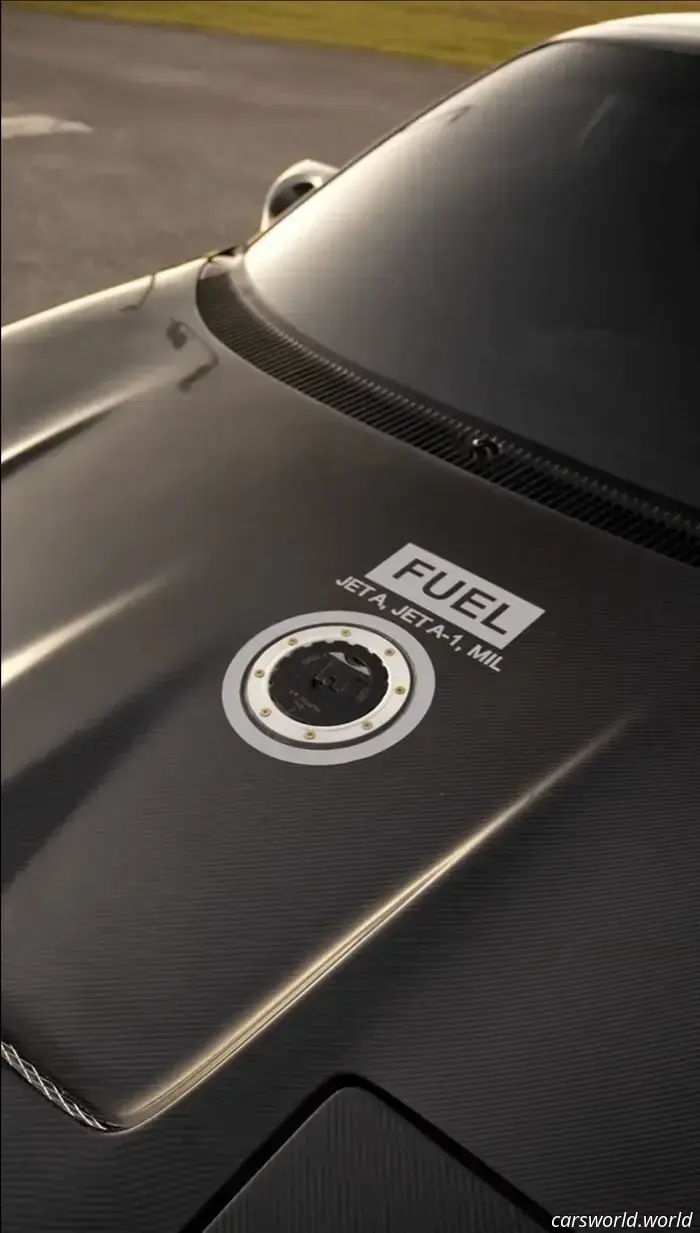
It operates on jet fuel (of course), which is stored in a seven-gallon tank located in the frunk. Brice doesn’t use it all the time, comparing it to nitrous injection. Unlike a conventional belt-driven supercharger, it doesn’t need engine power to run, and unlike a turbocharger, it has no exhaust flow limitations. “I still utilize an intercooler because the discharge air from the turbine is extremely hot,” Brice noted. “It exceeds 400 degrees Fahrenheit.”
“I don’t run the turbine frequently,” Brice mentioned. “I mainly operate it when I’m tuning, typically on the interstate—when I’m cruising—because I can turn it on or off without worrying about noise. Otherwise, the flames you see are just for show, and that doesn’t happen all the time.
“Other than the noise, you wouldn’t truly notice it’s operating.”
Brice emphasized that the current configuration of the car is more of a proof of concept than anything else. It’s the outcome of spontaneous late-night tinkering sessions in his garage, purely to explore what can be achieved with a turbine functioning as a supercharger on a piston engine. The 2GR-FE has shown to be the ideal test subject, as it doesn’t require upgraded internals to accommodate the boost from the Chinook APU.
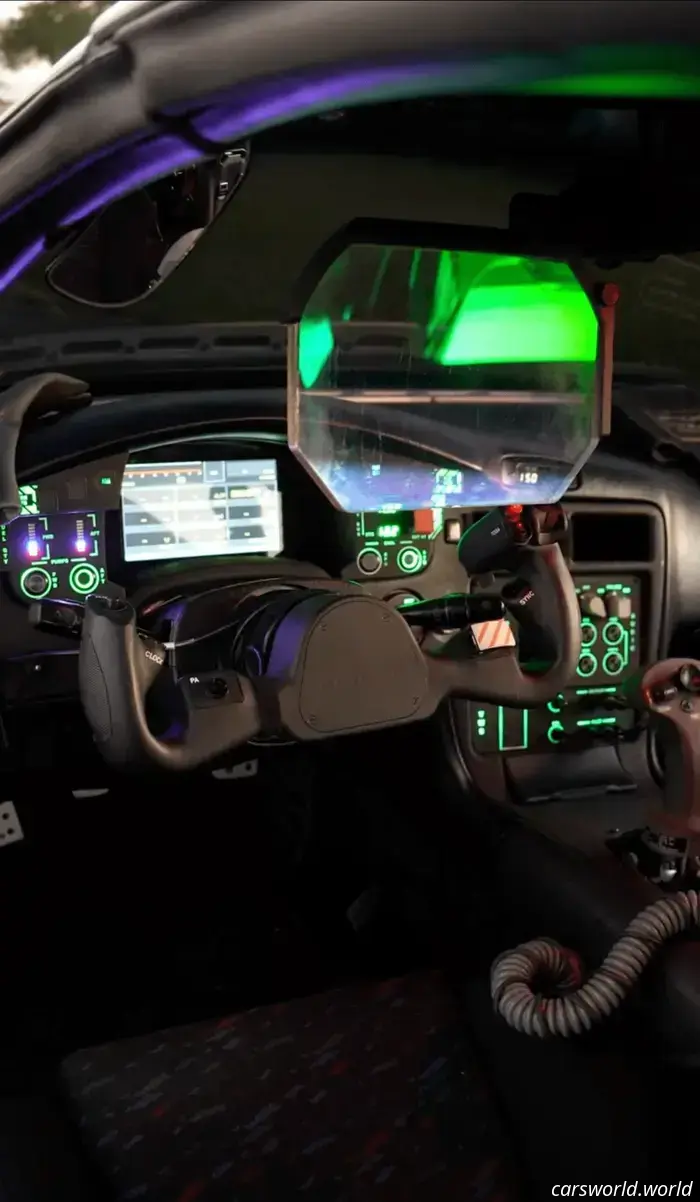
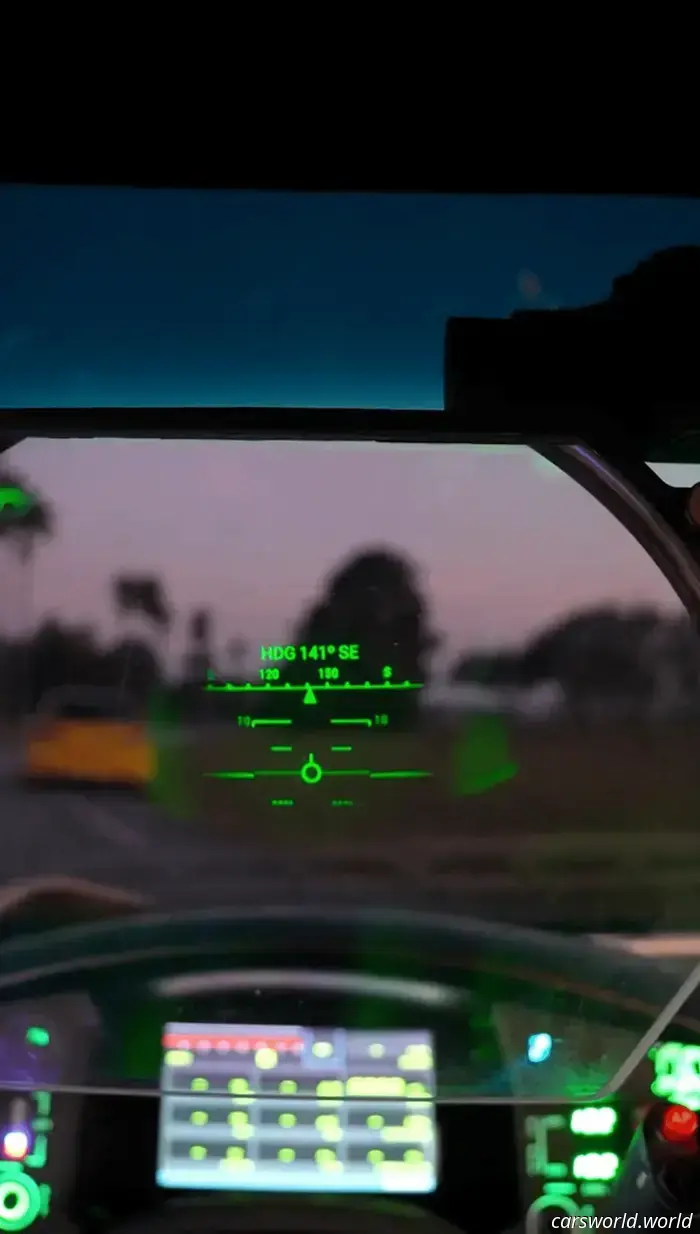
If you’re questioning why someone would choose this method instead of installing a turbo or a standard supercharger, I would argue you might be missing the point. Not everyone builds cars solely for maximum performance, although many do. Some individuals pursue their projects simply because it’s what they enjoy. Look at the rest of Brice’s car, and you’ll discover that the jet-fighter aesthetic takes precedence over sheer efficiency. It would certainly be simpler to drive fast without the yoke steering wheel, heads-up display, and chunky joystick shifter. But you know what? It would also be a lot less impressive.
When I asked Brice how he responds to critics with seemingly better ideas, he said he simply tells them, “I like Toyotas, and I enjoy jet noise.”
Have a tip or question for the author? Contact them directly: [email protected]
Other articles
 The Identical Individuals Offering You This Florida License Plate Frame Might Also Issue You a Ticket for It | Carscoops
Florida motorists encounter conflicting signals as sheriffs support the use of plate frames amid the implementation of a strict new law.
The Identical Individuals Offering You This Florida License Plate Frame Might Also Issue You a Ticket for It | Carscoops
Florida motorists encounter conflicting signals as sheriffs support the use of plate frames amid the implementation of a strict new law.
 Nissan Set to Double Its Performance Range While Teasing Secret Sports Car | Carscoops
The performance brand aims for worldwide expansion by introducing additional Nismo models, a race-engineered sports car, and enhanced restoration and customization initiatives.
Nissan Set to Double Its Performance Range While Teasing Secret Sports Car | Carscoops
The performance brand aims for worldwide expansion by introducing additional Nismo models, a race-engineered sports car, and enhanced restoration and customization initiatives.
 This New Corvette Might Be the Ideal Option We've Anticipated | Carscoops
The latest trim of the Chevrolet Corvette could potentially overshadow the E-Ray, surpass the Stingray in sales, and revive a historic performance name.
This New Corvette Might Be the Ideal Option We've Anticipated | Carscoops
The latest trim of the Chevrolet Corvette could potentially overshadow the E-Ray, surpass the Stingray in sales, and revive a historic performance name.
 Reasons Behind GM's Discreet Closure of Several Plants for More Than a Month | Carscoops
Prolonged shutdowns at important GM locations suggest that larger transformations may be on the horizon, with one improvement potentially related to a next-generation engine.
Reasons Behind GM's Discreet Closure of Several Plants for More Than a Month | Carscoops
Prolonged shutdowns at important GM locations suggest that larger transformations may be on the horizon, with one improvement potentially related to a next-generation engine.
 Honda's 2026 Pilot Saw Minimal Changes, But the Price Increased Significantly | Carscoops
The 2026 Pilot features a discreet redesign, enhanced technology, and a rise in prices for all trims, which includes higher destination charges.
Honda's 2026 Pilot Saw Minimal Changes, But the Price Increased Significantly | Carscoops
The 2026 Pilot features a discreet redesign, enhanced technology, and a rise in prices for all trims, which includes higher destination charges.
 Ford Scrapped More EVs Than You Might Think | Carscoops
The automaker is undergoing a significant strategic shift, moving away from three electric vehicles to focus on hybrids, range-extended trucks, and battery storage.
Ford Scrapped More EVs Than You Might Think | Carscoops
The automaker is undergoing a significant strategic shift, moving away from three electric vehicles to focus on hybrids, range-extended trucks, and battery storage.
This Toyota MR2, equipped with a supercharger from a Chinook helicopter turbine, can shoot flames.
The turbo in your car can't compare to this helicopter APU—at least not in terms of drama.