
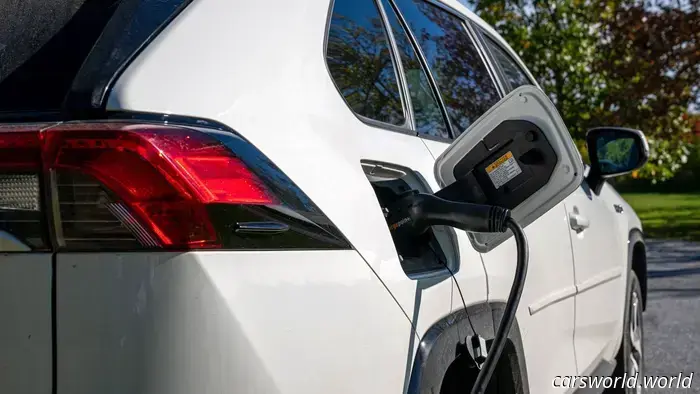
Your Plug-In Hybrid Emits More Pollution If You're Not Charging It Regularly.
Robert Nickelsberg/Getty Images
The most important car news and reviews, straight to the point
Sign up for our free daily newsletter to receive the stories that truly matter every weekday.
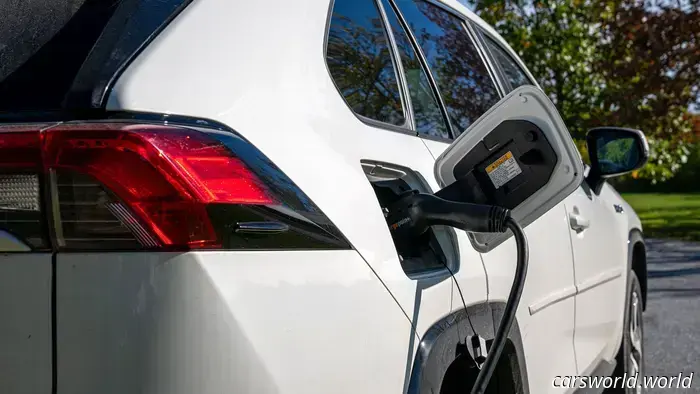
Plug-in hybrids, or PHEVs, are frequently viewed as a more practical compromise between traditional gasoline vehicles and fully electric ones for many Americans, utilizing advanced technology to improve efficiency and performance compared to standard hybrids. However, this is largely dependent on how they are utilized, and a recent study from China emphasizes that if you don’t intend to charge your plug-in hybrid, it might be wiser to opt for a conventional hybrid.
The study, which will appear in a forthcoming issue of the journal Transport Policy, analyzed 500 daily-driven plug-in hybrid vehicles in Shanghai, considering various charging habits. The researchers highlight that PHEVs can primarily be categorized into two operational modes: Charge-Depleting (CD) mode and Charge-Sustaining (CS) mode.
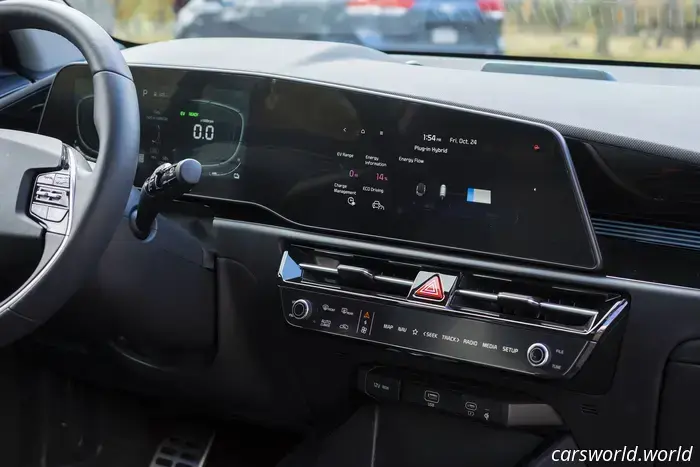
CD mode is where you want to stay as much as possible, as it indicates that the vehicle’s battery is being actively used. In this mode, you benefit fully from electric power, whether through its all-electric range or immediate torque. When the vehicle shifts to CS mode, the combustion engine is primarily in use, using most of its power while directing only a small amount of energy to the battery to maintain its minimal charge, which is also aided by regenerative braking.
This Kia Niro PHEV demonstrates a clear charge-sustaining mode. Adam Ismail
The efficiency improvements of a PHEV operating in ideal CD mode compared to a traditional hybrid can be quite substantial—at least in controlled conditions. Research indicates that PHEVs with fully charged batteries might emit 40% to 60% less nitrogen oxide than standard gasoline vehicles in urban settings. However, such figures greatly diminish in real-world applications, showing closer to a 20% reduction. Furthermore, emissions increase dramatically once the battery runs out and requires recharging again.
“Infrequent charging leads to a significant rise in nitrogen oxide, hydrocarbons, and carbon dioxide emissions,” the Transport Policy study states. “In the worst-case scenario where users never recharge their PHEVs, emissions can increase by 62% for nitrogen oxide, 70% for hydrocarbons, and 46% for carbon dioxide, respectively.” This is measured against their emissions in a CD state.
In CS mode, the PHEV operates less efficiently and with reduced performance compared to a conventional hybrid. It carries a substantial battery pack without utilizing its energy. For perspective, an internal combustion engine-only all-wheel-drive Mitsubishi Outlander weighs 3,900 pounds, whereas its plug-in hybrid version weighs 4,600 pounds. Additionally, a Kia Niro PHEV is 250 pounds heavier than its base conventional hybrid variant.
With a depleted battery, the combustion engine in a PHEV must work harder and longer. This inevitably leads to poorer fuel economy and, as the researchers indicate, more pollution.
Plug-in hybrids certainly have advantages, but much like pure battery-electric vehicles, they must align with your daily routine for you to truly benefit from them. The significant difference is that if you neglect to charge your electric vehicle, you won’t be able to drive it; the owner must adjust their usage behaviors accordingly. On the other hand, if you’re inconsistent with charging your PHEV, you can still drive it, but it will end up costing you more than if you had never purchased one in the first place.
Have a tip? Let us know at [email protected]
Other articles
 There’s Only One, and It Could Be the Tiniest GR Supra Ever Made | Carscoops
The GR Supra from Toyota receives a small homage as NATS students unveil a kei roadster featuring genuine components and an eye-catching body kit.
There’s Only One, and It Could Be the Tiniest GR Supra Ever Made | Carscoops
The GR Supra from Toyota receives a small homage as NATS students unveil a kei roadster featuring genuine components and an eye-catching body kit.
 This 1959 IH Semi Truck available for sale features windshields positioned below the driver's knees.
A long-forgotten International Harvester Sightliner has resurfaced, and even better, it is operational and drives well.
This 1959 IH Semi Truck available for sale features windshields positioned below the driver's knees.
A long-forgotten International Harvester Sightliner has resurfaced, and even better, it is operational and drives well.
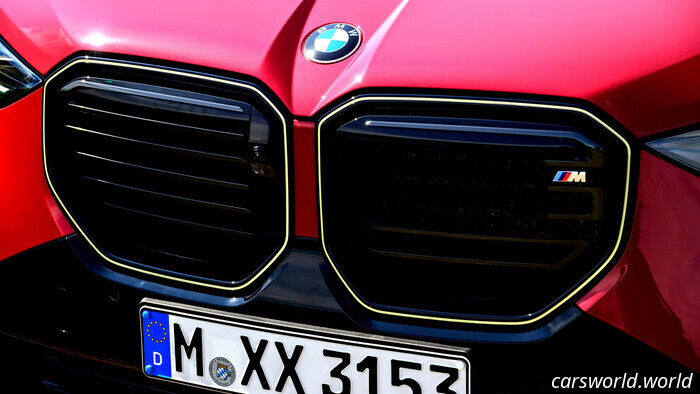 The BMW That Everyone Dislikes Was M's Top-Selling Model | Carscoops
BMW M's performance in 2025 achieved another milestone as customers overlooked criticism of the design, although sales of electric models declined in the fourth quarter.
The BMW That Everyone Dislikes Was M's Top-Selling Model | Carscoops
BMW M's performance in 2025 achieved another milestone as customers overlooked criticism of the design, although sales of electric models declined in the fourth quarter.
 Ford Reduced Parts Prices for Older Vehicles, but Excluded American Drivers | Carscoops
Thousands of authentic parts receive significant discounts to help maintain older Fords on the road in Europe.
Ford Reduced Parts Prices for Older Vehicles, but Excluded American Drivers | Carscoops
Thousands of authentic parts receive significant discounts to help maintain older Fords on the road in Europe.
 Jeep Believes Lowering Wrangler Prices Will Increase Sales | Carscoops
Stellantis reduces the price of the 2026 Wrangler and cuts back on expensive options, intending to regain buyers by offering increased value.
Jeep Believes Lowering Wrangler Prices Will Increase Sales | Carscoops
Stellantis reduces the price of the 2026 Wrangler and cuts back on expensive options, intending to regain buyers by offering increased value.
Your Plug-In Hybrid Emits More Pollution If You're Not Charging It Regularly.
Recent data indicates that you might want to rethink purchasing a plug-in hybrid if you do not intend to charge it frequently.