
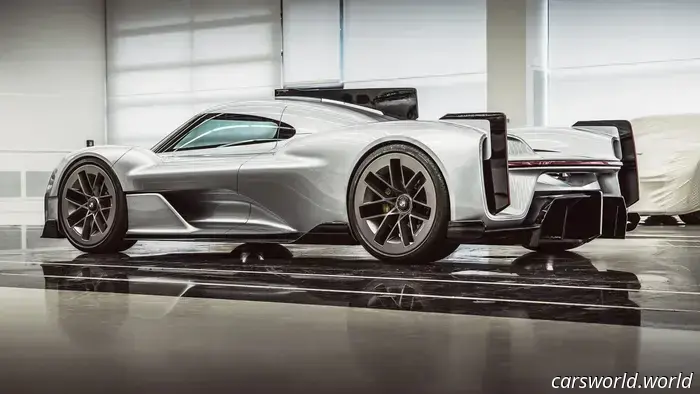
Porsche's Innovative W18 Engine Concept Could Make Its Upcoming Hypercar Truly Unique.
The 2017 internal design study of the Porsche 919 Street is a concept that truly deserved to be mass-produced.
Porsche
The latest news and reviews about cars, with no nonsense.
Subscribe to our free daily newsletter to receive the most significant stories directly to your inbox every weekday.
Patents offer intriguing insights; while they don’t guarantee the production of any upcoming vehicle, they do reflect the direction an automaker is taking. A recent patent published by the World Intellectual Property Office for a W18 engine from Porsche raises questions, especially considering the manufacturer's current offerings and strategies. Although Stuttgart appears to be scaling back its ambitious plans for electric vehicles, the idea of an engine boasting 10 more cylinders than any currently available seems like a notable deviation from the trend towards smaller combustion engines and the push for greater power through electric and forced induction technologies.
Thanks to CarBuzz for noticing this patent, which was released on October 16 and initially filed last December. The application includes two illustrations: a frontal view clearly showing the proposed three banks of six cylinders and an isometric view. Volkswagen enthusiasts will recognize that this W18 engine differs fundamentally from the W12 engine found in models like the Phaeton, and the W16 used in the Bugatti Veyron and Chiron. The latter designs are more akin to Volkswagen’s VR6 layout, where pistons are staggered at a narrow bank angle, integrating two banks into a single cylinder head. Doubling the VR6 yields a W12, and adding two additional pistons on each side results in a W16.
However, this proposed W18 is distinctly different. It embodies what one might envision for a W18 engine without prior knowledge of Volkswagen's earlier designs. It's a tri-headed powerhouse featuring three rows of six cylinders. One advantage touted in the documentation is that the intakes for each bank are positioned directly on top, as opposed to at a perpendicular angle, which helps reduce airflow losses caused by friction. The exhaust ports would be positioned lower on the side, and keeping these two channels separated could theoretically enhance thermal efficiency.
Two illustrations from Porsche's patent application for an "Internal combustion engine with a W-cylinder arrangement." Porsche via WIPO
Porsche also considers options with fewer cylinders per bank, including a 12-cylinder arrangement made up of groups of four. Additionally, it mentions, as translated by Google, that “each cylinder bank is preferably associated with an exhaust gas turbocharger,” suggesting a triple-turbo powertrain. That sounds promising.
This leads to the question, “How and where might Porsche implement this?” There’s a noticeable revival in internal combustion engine development as nearly every automaker has abandoned plans to completely eliminate gasoline engines by the end of this decade or the next. We hope that Porsche seizes this opportunity to unveil something genuinely unique, similar to what Bugatti achieved with the naturally aspirated V16 in the Tourbillon, which revs up to 9,000 rpm. In this electric motor era, sheer power doesn’t make a vehicle extraordinary anymore; it’s the method of achieving that power that distinguishes you.
Most likely, this W18 concept will end up filed away like other patents, perhaps serving as the foundation for a future lawsuit. However, there’s plenty of potential for it to evolve into something more significant. After all, how long has it been since the 918 Spyder was released?
Have a tip? Send us an email at [email protected].

Other articles
 Isuzu Believes Drivers Still Prefer Sturdy 4WDs Despite the Dominance of Soft SUVs | Carscoops
The special edition Tour Mate of the truck-based SUV features a variety of optional accessories.
Isuzu Believes Drivers Still Prefer Sturdy 4WDs Despite the Dominance of Soft SUVs | Carscoops
The special edition Tour Mate of the truck-based SUV features a variety of optional accessories.
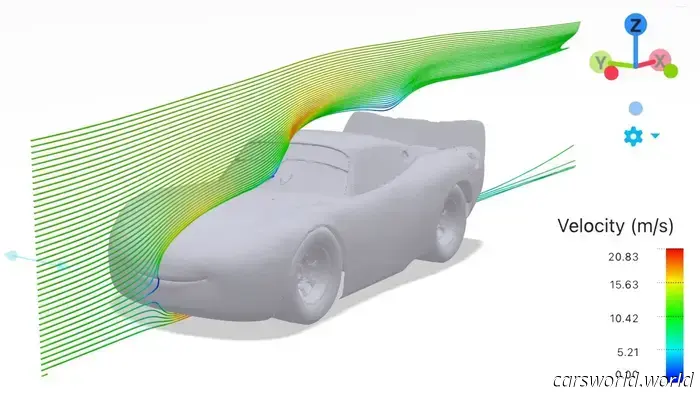 Lightning McQueen Aero Analysis Part 2: You Can Now Interact with the 3D Model Yourself
3D models of Lightning McQueen and Jackson Storm have been uploaded to AirShaper's CFD analysis platform, where you can interact with them on your own computer.
Lightning McQueen Aero Analysis Part 2: You Can Now Interact with the 3D Model Yourself
3D models of Lightning McQueen and Jackson Storm have been uploaded to AirShaper's CFD analysis platform, where you can interact with them on your own computer.
 We're introducing a Spy Shot Newsletter to deliver the future of automobiles straight to your inbox.
Have you ever wondered how car websites like ours obtain those prototype spy photos? Spyglass will provide you with the same insider access.
We're introducing a Spy Shot Newsletter to deliver the future of automobiles straight to your inbox.
Have you ever wondered how car websites like ours obtain those prototype spy photos? Spyglass will provide you with the same insider access.
 Xiaomi Will Need to Compensate Owner for Deception | Carscoops
Xiaomi Will Need to Compensate Owner for Deception | Carscoops
Xiaomi Will Need to Compensate Owner for Deception | Carscoops
 The Secret Wild Mustang GTD Aims for Retribution Against the Corvette ZR1 | Carscoops
Ford is developing a high-performance Mustang GTD aimed at reclaiming the Nürburgring lap record for American automakers.
The Secret Wild Mustang GTD Aims for Retribution Against the Corvette ZR1 | Carscoops
Ford is developing a high-performance Mustang GTD aimed at reclaiming the Nürburgring lap record for American automakers.
 Totem Created an Alfa So Gorgeous It Might Make a Ferrari Feel Ashamed | Carscoops
The starting price for this exclusive Alfa Romeo-based coupe is $625,000, indicating that it is targeted at a specific group of clients.
Totem Created an Alfa So Gorgeous It Might Make a Ferrari Feel Ashamed | Carscoops
The starting price for this exclusive Alfa Romeo-based coupe is $625,000, indicating that it is targeted at a specific group of clients.
Porsche's Innovative W18 Engine Concept Could Make Its Upcoming Hypercar Truly Unique.
We are optimistic that the W-shaped engine recently suggested by Porsche will become more than just a few patent sketches. What do you think about a successor to the 918 Spyder?